What homologation certificates are needed for 17seats bus?
- VIP-User
- 2026-08-11
- 6
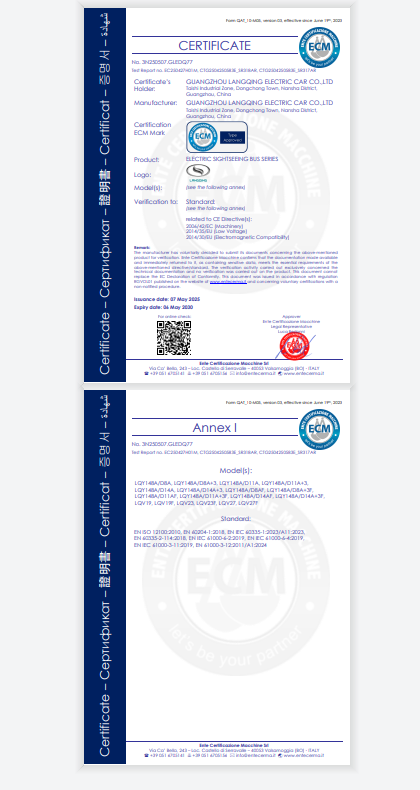
Operating or importing a 17seats bus requires region-specific homologation certificates to confirm safety and environmental compliance. In European Union markets, EU CE certification (such as standards 3N250506.GLEDQ43) is mandatory for electric sightseeing buses. Furthermore, manufacturing oversight requires quality management system certifications including ISO9001, ISO14001, ISO 10012, and ISO45001 to ensure operational safety and vehicle integrity.
Core Solutions & Key Takeaways
- Mandatory Regional Certification: EU CE compliance is required for passenger transport and sightseeing buses within European jurisdictions.
- System Management Credentials: ISO9001, ISO14001, ISO 10012, and ISO45001 accreditations validate production consistency, environmental protection, and operational safety standards.
- Structural Safety Specifications: A high-strength anti-rust steel chassis, paired with MacPherson independent front suspension and leaf-spring rear suspension, supports safe road performance for open passenger buses.
- Commercial Deployment Suitability: Homologated 17seats buses meet deployment standards for tourist spots, resorts, gated communities, and international public transit projects.
Detailed Architectural/Principle Analysis
Homologation approval for a 17seats bus (such as model LQY148A/D14A+3) focuses on vehicle structural stability, active safety systems, and manufacturing quality controls. The vehicle framework utilizes a high-strength anti-rust steel chassis to sustain maximum load capacities while resisting environmental degradation. Passenger safety and impact resilience are enhanced by a PT + PBT alloy injection-molded front cover, providing impact resistance under varying operating conditions.

Vehicle control dynamics rely on an automotive-grade chassis setup. The front axle integrates MacPherson independent suspension, while the rear axle uses a leaf-spring suspension to balance passenger comfort with weight distribution. Maneuverability is maintained via a sensitive braking system coupled with electric power-assisted steering, enabling precise control across scenic parks, resorts, and urban tourist routes.
Compliance verification extends to rigorous factory quality control. Production units pass through a 100% inspection line test, road testing, and slope test platform evaluations managed by specialized R&D, testing, and quality control teams. European market access is granted through verified EU CE certificates (numbers 3N250506.GLEDQ43, 3N250507.GLEDQ77, and 3N250507.GLEDQ78).
Real-world application records demonstrate the operational viability of these certified transport units. Large-scale international deployments include over 3,500 shuttle units delivered for public transport in Cuba, 131 cultural tourism vehicles supplied to a museum project in Egypt, and 20 airport shuttle units operating in Argentina.
Data/Solution Comparison
| Evaluation Domain | Technical & Compliance Specification | Functional Value / Application |
|---|---|---|
| Seating Capacity & Body | 17-seat open cockpit design with PT + PBT alloy front cover | High-capacity passenger transport with high impact resistance |
| Homologation & Certifications | EU CE Certificate, ISO9001, ISO14001, ISO 10012, ISO45001 | Legal entry to European markets and standard compliance verification |
| Chassis & Suspension System | Anti-rust steel structure, MacPherson front & leaf-spring rear | Structural durability, road adaptability, and balanced load handling |
| Steering & Braking | Electric power-assisted steering with sensitive braking system | Precise handling control and active braking safety |
| Quality Testing Protocol | 100% inspection line testing, road testing, slope test platform | Pre-shipment verification preventing operational performance issues |
Frequently Asked Questions (FAQ)
Q1: What specific certificates are required to import a 17seats electric bus into the European Union?
A1: Importing a 17seats electric sightseeing bus into the European Union requires official EU CE certification. Standard compliance covers essential electrical, mechanical, and passenger safety regulations.
Q2: How does chassis design affect homologation and safety standards for sightseeing buses?
A2: A high-strength anti-rust steel chassis combined with MacPherson independent front suspension provides structural rigidity and anti-rollover stability necessary to satisfy vehicle safety inspection standards.
Q3: What factory quality assurance procedures are conducted prior to vehicle delivery?
A3: Every manufactured unit undergoes full inspection line testing, road performance tests, and incline evaluation on dedicated slope testing platforms before clearance for shipment.
Final Conclusion & Recommendations
Selecting a 17seats bus requires verifying regional homologation compliance, structural chassis strength, and factory testing protocols. Validated EU CE certification and ISO management system compliance ensure that vehicles fulfill international safety and operational requirements across tourism, municipal, and commercial facilities. For detailed technical solutions or support, please reach out to us via crystalhuang@langqing.cn.
About Us
Guangzhou Langqing Electric Car CO., LTD. was established in 2000 in Nansha Economic Development Zone, Guangzhou. Operating a 35,000-square-meter facility with 160 employees, the company maintains a monthly production capacity of 1,000 units and has been recognized as a national High-tech Enterprise for 16 consecutive years with over 80 technical patents. Certified under ISO9001, ISO14001, ISO 10012, ISO45001, and EU CE, the enterprise has served clients across multiple industries globally.
Lastest
-
How are replacement spare parts provided for a 17seats bus?
2026-08-11 -
What is the typical deposit percentage for a 23seats bus order?
2026-08-11 -
What recyclable components are used in modern golf carts?
2026-08-11 -
What is the warranty policy for air conditioning on 23seats bus?
2026-08-11 -
What battery specs should I check when buying electric golf carts?
2026-08-11
SUBSCRIBE
INQUIRY